
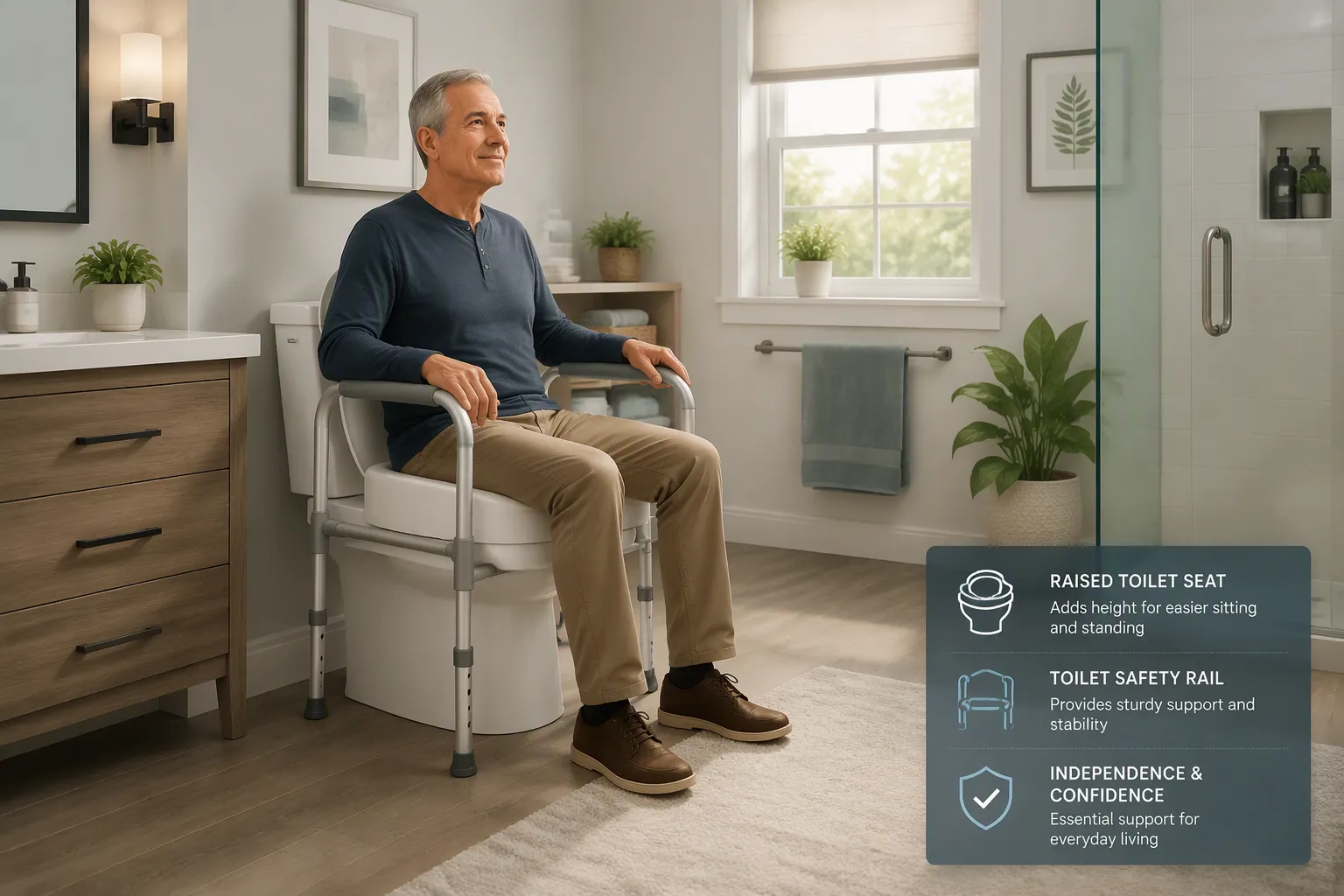
Picture this: you wake up at night and shuffle to the bathroom. The floor feels cold and slick under your feet. One wrong step could send you tumbling. That fear is real for millions of older adults. According to the CDC, fall injuries are the leading cause of injury-related deaths among adults 65 and older, and bathrooms are a common spot for these accidents. So how do you pick the right bathroom safety aid? The choice often comes down to toilet safety rails vs. raised toilet seats. Each one solves a different problem. Let’s break them down side by side so you can choose what keeps you safe and steady.
Key Takeaways
Toilet safety rails give you handles to push and pull. They help with balance and leverage.
Raised toilet seats add height. They reduce bending for sore joints.
Choose rails if you wobble or need arm support. Choose a riser if bending hurts.
You can use both together for more safety. Some products combine them.
Measure your toilet and space before buying. Check weight capacity and stability.
Clean and check your device often. Tighten loose parts to prevent falls.
Talk to your doctor or therapist if unsure. They help you pick the right aid.
What Are Toilet Safety Rails?
Definition and Purpose
Toilet safety rails are metal or plastic frames that attach to your toilet. They have handles on both sides. These rails give you something to hold when you sit down or stand up. They do not make the seat higher. Instead, they help you push or pull with your hands.
You can find toilet safety rails that fit round and long toilets. Most models clamp onto the bowl without tools. Some freestanding versions rest on the floor around the toilet. The goal is simple: give your hands a firm spot to push or pull. This extra support helps you control how you move.
How Toilet Safety Rails Provide Leverage
A toilet safety rail works like a lever for your body. When you push down on the handles, you take weight off your legs and hips. A peer-reviewed study cited in research shows that using bilateral grab bars at the correct height and width significantly reduced peak ankle, knee, and hip joint moments during toilet transfers. The rail acts as a biomechanical lever. It lowers the muscle effort and joint strain you need to stand. This cuts your risk of losing balance and falling.
For best results, the rail should support your full sit-to-stand motion. Two points of contact work well. A horizontal rail lets you pull forward and up. A second rail lets you push against during the final rise. This builds a steady support zone that matches your body’s natural movement path.
A standard-height toilet forces the hip to bend well beyond 90 degrees, putting direct stress on the new joint and surgical site, which dramatically increases the risk of hip dislocation.
– Queensland Health Clinical Guidelines, Total Hip Replacement Precautions and Bathroom Equipment
Who Benefits Most from a Toilet Safety Frame
A toilet safety frame helps many people. The largest group is older adults. One study found that 41.9% of respondents using these devices were aged 65–70, with the full range spanning 65–85 years. About 37.9% of those respondents had chronic conditions like diabetes, arthritis, or chronic kidney disease. Most (73%) lived with family or others, which supports device adoption.
You may benefit from a toilet safety rail if you fall into any of these groups:
Elderly individuals (aged 65+) at greater risk of chronic illnesses and disabilities such as Parkinson’s disease, dementia, osteoporosis, and rheumatoid arthritis.
Physically challenged individuals with mobility limitations from stroke, spinal cord injury, multiple sclerosis, or paralysis.
Post-surgery patients who need short-term support for rehabilitation and fall prevention.
Individuals with chronic conditions like diabetes, cardiovascular disorders, and neurological disorders.
These safety rails are great if you have balance problems or a shaky standard toilet. They give you the steadiness you need to use the bathroom with confidence.
What Are Raised Toilet Seats?

Definition and Purpose
A raised toilet seat is a plastic or padded ring that sits on top of your existing toilet bowl. It adds height so you do not have to lower yourself as far. Think of it like a booster seat for the bowl. You install it right over the existing fixture. Clips or brackets hold it in place.
The main job of a raised toilet seat is simple. It reduces the distance you travel when you sit down or stand up. That smaller gap means less bending at your hips and knees. But here is the catch. A standard raised toilet seat does not give you hand support. You still need a grab bar or a nearby counter if you need help balancing.
Some models combine a toilet seat riser with built-in armrests. Those models are called a toilet seat with handles. They offer both added height and something to hold onto. A good toilet seat riser can improve your comfort and your bathroom routine. Some designs also add comfort or pressure relief with padded surfaces. You just need the right amount of added height for your body.
How Raised Toilet Seats Reduce Bending
Here is how you find the right height. Measure from the floor to the back of your knee while you stand in flat shoes. That number is your ideal seat height. Subtract your current seat height from that number. The result tells you how much added height you need.
A 2-inch lift works for minor stiffness or general aging. A 3 to 4 inch lift is the most common range for surgery recovery and moderate mobility limits. A 5 to 6 inch lift works for significant restrictions or very tall users. Physical therapists recommend your hips sit at roughly a 90-degree angle. Your knees should be level with or slightly lower than your hips. This position reduces joint strain.
Here is how different setups compare:
Toilet Configuration | Total Sitting Height | ADA Compliant? |
|---|---|---|
Standard toilet (no riser) | 15-16 inches | No |
Standard + 3.5″ raised seat | 18.5-19.5 inches | Yes (effective) |
Standard + 5″ raised seat | 20-21 inches | Exceeds ADA range |
The ADA mandates 17-19 inches for accessible facilities. A 3.5-inch toilet seat riser brings a standard toilet into that range. A 5-inch toilet seat riser goes beyond it.
When you use a toilet seat riser, your hips and knees bend less. That means less pain for sore joints. The added height also gives you better leverage with your legs. Standing takes less effort. For people with knee or hip arthritis, this reduced bending directly lowers pain during each visit. The added height helps you maintain stability as you stand.
Who Benefits Most from a Raised Toilet Seat
A raised toilet seat helps several groups. The biggest group is anyone recovering from hip or knee replacement. A survey of 170 UK occupational and physical therapists found that 97% advised hip precautions after surgery. Most recommended a toilet seat riser for 6 to 8 weeks. A Cochrane systematic review also lists raised toilet seats as standard equipment after hip replacement. This period of surgery recovery requires careful attention to every movement.
People with arthritis or chronic joint pain also benefit. When you have arthritis, every bend hurts. The added height from a toilet seat riser reduces strain on your knees, hips, and back. Less strain means less pain.
If you have general age-related stiffness, a toilet seat riser can help too. You might not need surgery. But you still struggle with low bowls. A small amount of added height can restore your independence in the bathroom.
When you shop, look for key safety features. A locking mechanism prevents the riser from sliding sideways. A non-slip surface stops you from sliding forward. Some models include a toilet seat with handles or padded armrests for extra stability. Always check the weight capacity. Heavy-duty options exceed 300 pounds.
Before you sit, confirm the seat is firmly locked. Check for zero movement. Use both armrests when you lower or rise. Keep the path clear. These daily safety habits keep you protected.
Toilet Safety Rails vs. Raised Toilet Seats
When you compare toilet safety rails vs. raised toilet seats, the choice depends on what kind of help you need most. One tool gives you leverage to stand up. The other cuts down how far you have to bend. Neither one is best in every case. Your own problem decides the right pick. Let’s see how they compare in three key areas.
Height vs. Leverage
This difference is at the center of the toilet safety rails vs. raised toilet seats debate. A raised toilet seat makes your toilet bowl taller. You do not have to lower yourself as far down. That extra height means less bending in your hips and knees. A toilet seat riser usually adds 2 to 5 inches of height. That extra height shortens the space between standing and sitting. The added height takes weight right off your leg joints.
A toilet safety rail works in a different way. It does not change the seat height at all. It gives you handles to push and pull on. The rail acts like a lever for your arms. Your upper body does more work, so your legs do less. This helps if you feel unsteady or have weak leg muscles. The rail holds your body weight through your arms instead of your lower body.
Here is what the research says about both approaches.
No trial has tested whether raised toilet seats prevent falls. What has been measured is that raising the seat reduces the difficulty of standing up and lowers muscle activity in the thigh, shin and calf, meaning it genuinely takes load off the legs. That is a good reason to use one, and it is not the same as proven fall prevention.
Raised seats and bilateral grab bars both measurably reduce the difficulty and muscular demand of standing up. That is mechanism evidence, not proof they prevent falls.
What does that mean for you? If bending hurts, extra height helps. A toilet seat riser is your best choice. If you need something to hold for balance, a toilet safety frame gives you the leverage you need. Both tools make standing easier, but they use different parts of your body to do it.
Arm Support and Stability
This area shows a clear difference between the two aids. Toilet safety rails give you direct arm support. You get two strong handles on both sides of the toilet. You hold them tight and use your upper body to control each move. Most rails have non-slip grips on the handles and rubber feet or suction cups on the bottom. These features keep the rail steady when you put weight on it. That kind of steadiness gives you confidence as you move through each sit and stand motion.
Standard raised toilet seats do not give you arm support at all. A basic raised toilet seat is just a booster ring. You still need a grab bar, a nearby counter, or a wall to balance. The exception is a toilet seat with handles. This style mixes a riser with built-in armrests. You get both extra height and something to hold. This combo adds stability that a standard riser cannot match. The armrests give you a spot to steady yourself.
For overall stability, a toilet safety frame gives the most support. It goes around the toilet and gives you a steady point of contact through your whole sit-to-stand motion. The frame does not wobble or slide when you lean on it. You can push off with confidence and not worry about the device moving.
Installation and Portability
Installation methods are different for these aids. The type of rail you pick also affects portability. Here is how stand-alone and attachable rails compare:
Feature | Stand-Alone Rails | Attachable Rails |
|---|---|---|
Installation | No tools needed (freestanding) | Light installation required (tools may be needed) |
Tool-Free Setup | Yes, completely tool-free | No; requires some assembly with tools |
Portability | Highly portable; can be moved for travel or second bathroom | More permanent; not designed for frequent relocation |
Best for | Temporary, post-op, renters, travel | Long-term daily use, space-saving, discreet support |
Other rail options include:
Freestanding/portable rails: No tools required; stable base placed around toilet; ideal for travel or temporary use; must have non-slip feet for safety.
Foldable rails: Support when needed, fold away; suitable for small bathrooms; no permanent installation mentioned.
Adjustable rails: Flexible for different users; installation varies but often uses existing bolts or freestanding frames.
General installation time: Many models install in under 30 minutes, especially those using existing toilet bolts or freestanding frames.
Raised toilet seats install even quicker. Most clip onto the bowl without any tools. You can take them off in seconds when guests come over. This makes them a good fit for renters or anyone who wants a temporary solution.
Think about your bathroom layout when you choose. Do you have room for a freestanding frame? Or do you need something small? Do you travel a lot? A portable rail or a light toilet seat riser fits easily in a suitcase.
Which Aid Should You Choose?
You have seen how each device works. Now comes the real question. Which one belongs in your bathroom? The answer depends on your body, your daily struggles, and your home layout. Let’s walk through three common situations.
If Balance Is Your Main Concern
Your legs feel strong enough to lower and lift you. The problem is steadiness. You wobble at the midpoint. You reach for a wall that is not there. In this case, a toilet safety frame is your best pick. These frames give you two handles to grip through the whole motion. You control your descent and your rise with your arms. The frame does not move when you lean on it.
A basic raised toilet seat will not solve a balance problem. It adds height, but it leaves your hands empty. Worse, research shows that extra height can actually increase postural instability. In a controlled study of toilet transfers, elevating the seat cut the effort needed to stand by roughly 9%. But the same study found greater center-of-pressure movement during the transfer. That means more swaying. For someone with poor balance, that trade-off is risky. Clinicians often pair a raised seat with grab bars for this exact reason. If steadiness is your issue, choose the rails first.
If Bending Is Painful
Your balance is fine. Your knees, hips, or lower back just scream when you fold down to a low bowl. Here, a toilet seat riser is the right tool. It shortens the distance you travel. You bend less. Your joints hurt less.
Clinical guidance suggests that adding about 2 to 6 inches of height can meaningfully reduce this sit-to-stand distance. That range covers most users. A 2-inch lift suits minor stiffness. A 3 to 4 inch lift fits moderate limits. A 5 to 6 inch lift helps severe restrictions. Research shows that raising seat height and angle lowers activity in trunk and leg muscles. Less muscle effort means less strain.
One caution: height alone can backfire. When you raise only the seat, shorter elderly users may lose contact between their feet and the floor. That reduces stability because the trunk detaches from the ground. Adjusting both height and angle lets you keep your feet flat. This closed-chain position helps prevent forward and backward swaying. So if you go the riser route, look for an adjustable model. And consider adding a toilet seat with handles for extra security.
If You Need Both Together
Many people face both problems at once. Their joints hurt, and their balance is shaky. Good news: you do not have to pick one. You can combine both solutions. The source guidance is direct on this point. When both mobility and balance are concerns, using a raised seat with a safety frame improves safety and makes the movement smoother and more controlled.
You have two paths. The first is a combo unit. A raised seat with integrated handles, sometimes called toilet risers with arms, handles both needs in one product. This option works well when your bathroom is too tight for two separate devices. The trade-off? You cannot adjust seat height and arm height independently the way separate products allow.
The second path is a layered setup. Occupational therapists often recommend a three-layer configuration for higher-need users. Layer one: a raised seat for height correction. Layer two: wall-mounted grab bars on the adjacent wall for primary support. Layer three: safety rails on the toilet for close bilateral support. This gives you the most complete protection available.
Whichever path you take, check compatibility. Some brands note that their cushioned seats work with their safety rail designs. That kind of pairing gives you added height plus handrails for leverage. Your recovery or surgery recovery period will feel safer and more manageable. With the right setup, you keep your independence and your comfort. That is what every bathroom safety aid should deliver.
Extra Considerations Before You Buy
Measuring Your Toilet and Space
Before you order anything, grab a tape measure. You need to know your toilet’s current seat height and the clear space around it. The ADA sets a target seat height of 17 to 19 inches above the finished floor. You also need 60 inches of clear floor space in front of the toilet and a total clear area of 48 by 60 inches. If you plan to add grab bars, mount them 33 to 36 inches above the floor. A side wall grab bar should run at least 42 inches long, and a rear wall bar needs 36 inches minimum. These recommendations come from established accessibility guidelines, so check them against your layout.
Look for slip-resistant surfaces too. The ASTM E303 pendulum test is the trusted method for measuring floor slip resistance in wet areas. The ADA requires accessible surfaces to be slip resistant. Keep this in mind when you assess your bathroom floor.
Weight Capacity and Stability
Check the weight limit before you buy. Most raised toilet seats and toilet safety rails support up to 300 pounds. Foam seat risers typically hold 250 pounds. Grab bars must withstand at least 250 pounds of vertical or horizontal force. These ratings matter for your safety. A product that flexes or shifts under load puts you at risk.
Look for non-slip grips, rubber feet, or suction cups. These features keep the device steady when you lean on it. A locking mechanism on a raised toilet seat prevents sideways sliding. Test the product’s stability before you rely on it. Push down on the handles or the seat edge. If anything moves, tighten it or return it. Your comfort and security depend on a firm, stable setup.
Cleaning and Maintenance
Clean your bathroom safety equipment regularly. Raised toilet seats can harbor bacteria, so disinfect them thoroughly. Grab bars need gentle cleaning that does not loosen their mountings. Non-slip surfaces trap contamination in textured areas, so scrub those spots with care. Watch for rust on metal parts. Rust weakens the frame over time and shortens the product’s lifespan.
Check all fittings every few weeks. Tighten any loose screws or clamps. Look for cracks in plastic seats or worn rubber feet. Replace worn parts right away. A small fix now prevents a fall later. With proper care, your toilet safety aid will serve you well for years.
Here is the main point. Raised toilet seats add height so you bend less. Toilet safety rails give you leverage and support for steady moves. The choice between toilet safety rails vs. raised toilet seats depends on your mobility problem, bathroom setup, and personal comfort. Always put safety first. A fall can shake your confidence and your independence. Talk to your doctor or occupational therapist if you are unsure. They can help you pick the right bathroom safety aid for your needs. Measure your toilet today. Review the comparison above. Choose the tool that improves your overall bathroom accessibility. Safety rails give you the support you need. These safety rails keep you safe during every visit.
FAQ
Can I use a raised toilet seat and safety rails at the same time?
Yes. Many people combine both aids. A raised seat adds height, and rails give you handles to grip. Just check that the rail fits around your raised seat. Some combo units include built-in armrests for this exact setup.
Do toilet safety rails fit every toilet?
Most rails work with both round and elongated bowls. Freestanding frames sit around the toilet and need no attachment. Attachable models clamp onto the bowl. Measure your toilet first, since fit varies by brand and shape.
How much height does a raised toilet seat add?
Most risers add 2 to 5 inches. A 2-inch lift suits minor stiffness. A 3 to 4 inch lift fits moderate limits. A 5 to 6 inch lift helps severe restrictions. Pick the height that keeps your hips near a 90-degree angle.
Will a raised toilet seat work after hip replacement surgery?
Often, yes. A survey of UK therapists found 97% advised hip precautions after surgery, and most recommended a riser for 6 to 8 weeks. Pair it with grab bars or handles, since a basic riser gives no arm support.
Are toilet safety rails portable?
Freestanding rails are highly portable. You can move them between bathrooms or pack them for travel. Attachable rails are more permanent and not designed for frequent relocation. Raised seats clip on and off in seconds, which suits renters and temporary needs.
How much weight can these aids hold?
Most raised seats and safety rails support up to 300 pounds. Foam risers typically hold 250 pounds. Grab bars must withstand at least 250 pounds of force. Always check the rating before you buy, and test stability before you rely on it.
Do raised toilet seats prevent falls?
No study has proven that. Research shows raised seats reduce the effort and muscle activity needed to stand. That is not the same as proven fall prevention. If balance is your main worry, add rails or grab bars for steadier support.
How do I keep my bathroom aid clean and safe?
Disinfect raised seats regularly, since they can harbor bacteria. Clean grab bars gently so mountings stay tight. Scrub textured non-slip surfaces, which trap dirt. Check fittings every few weeks. Tighten loose screws and replace worn rubber feet right away.