
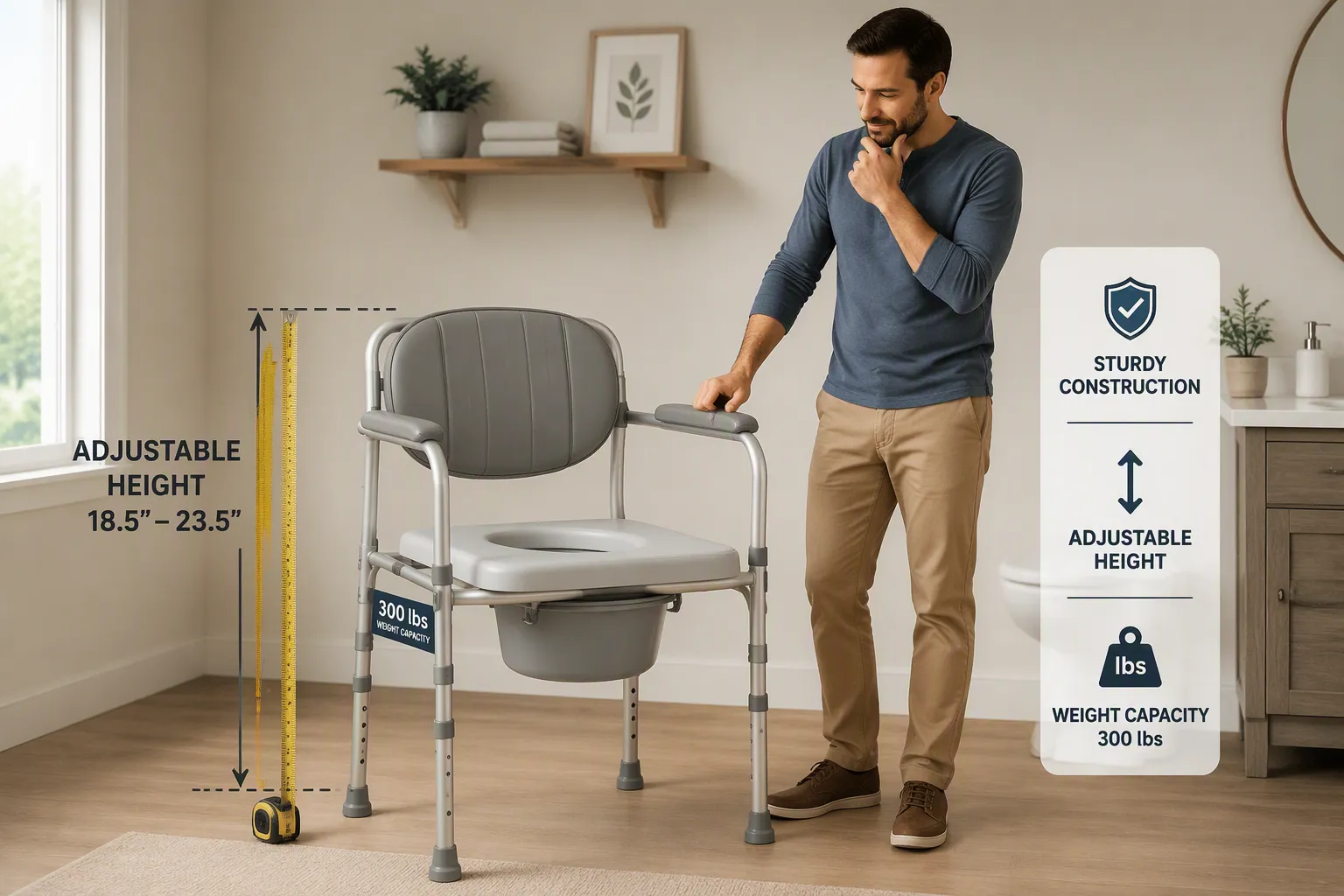
A bedside commode chair is a portable aid for nighttime use. A poorly chosen model can cause falls, skin breakdown, or discomfort. Six main types exist. The three critical factors are type, height, and weight capacity. A medical commode chair often has adjustable settings and removable armrests. Choosing the right commode chair depends on these factors. Safety and toileting support are critical for seniors. Locking wheels provide stability during transfers. This buyer’s guide explains each factor step by step. Measure the user and bathroom before buying. Adjustable settings allow a custom seat position. Armrests provide support during standing. Wheels with brakes lock in place. You can feel confident in your decision. This guide gives you peace of mind.
Key Takeaways
Pick the right commode type based on how the user moves and gets on and off it.
Measure the distance from the user’s hip to the floor to set the right seat height.
Check the weight limit and add 10% extra for safety and steadiness.
Check for safety features such as locking brakes and non-slip feet.
Adjustable seats and drop-arm models make moving safer and easier.
Wash the commode every day and use disinfectant once a week to stop germs.
Swap out old parts such as rubber tips and cracked seats to prevent falls.
A good commode chair gives you back your freedom and helps you feel calm.
Types of Commode Chairs: Six Main Categories
Today, you can find six common types of commode chairs for sale. Each type fixes a different problem. Some help you move over from a wheelchair. Others fold flat so you can take them on trips. A few can hold much more weight than a normal frame. Learning about the types of commodes before you shop stops you from buying the wrong one.
Bedside and Drop-Arm Models
Standard Bedside Design
A bedside commode chair sits next to the bed and makes the trip to the bathroom shorter. This is important because falls in the bathroom are a top cause of injury for older adults. A chair placed close by cuts the walking distance and limits trips across slippery floors at night. Standard bedside models come in two kinds. The non-adjustable frame is lighter and costs less, but it locks you into one seat height. The adjustable version lets you raise or lower the seat to fit the user’s leg length. Adjustable height, drop arms, and wheels also cut down on awkward lifting and repeated transfers, which lowers the risk of caregiver injuries. For a commode chair for home use, the adjustable frame usually works better over time.
Drop-Arm for Side Transfers
A drop-arm commode has armrests that lower out of the way. The user can then slide sideways from a bed or wheelchair instead of standing, turning, and lowering over a fixed arm. This design removes the armrest barrier and allows a straight-across slide. That path is safer and easier for wheelchair users who cannot stand for long or bear much weight. It also lowers caregiver strain by avoiding a lift over a fixed arm. One RESNA conference paper describes a wheelchair with drop-down armrests built for sliding transfers. The paper notes that transfer boards are unstable, can slide off the wheelchair, and are often misplaced, which raises fall risk. Drop-down arms remove the need for a separate board. The arm usually drops at the touch of a button, which clears the side of the chair.
Foldable and Wheeled Options
Portability for Travel
A foldable commode collapses into a flat package. You can store it in a closet or load it into a car for a trip. The trade-off is a lighter frame, so check the stated weight capacity before you buy. These models suit travelers and households with limited storage space.
Locking Casters for Stable Mobility
A wheeled commode rolls into the bathroom for shower or toilet use. Locking casters keep the frame still during transfers. Locking wheels and brakes exist to ensure stability and prevent unintended movement during patient transfers. For seniors, fall prevention features such as non-slip feet and locking brakes rank among the most important safety elements. Follow this routine every time.
Mistake | Risk | Correct Practice |
|---|---|---|
Not locking brakes | Chair movement leads to a fall | Always lock wheels before transfers |
Lock all wheels before the user approaches or stands. Confirm the lock visually and with a gentle push test. Recheck the locks after you reposition the chair.
Bariatric and Shower Commodes
Heavy-Duty Weight Capacity
A bariatric commode uses a reinforced frame and a wider seat. It supports a much higher weight capacity than a standard unit. The wider opening also gives the user more room. These models weigh more, so moving them takes extra effort. Choose this type when the user’s weight sits near or above the limit printed on a standard frame.
Water-Resistant Construction
A shower commode goes into the wet area, so its materials must resist moisture and cleaning products. Stainless steel resists corrosion and keeps its structural strength despite repeated contact with water. Non-porous surfaces prevent water penetration and make hygiene maintenance easier.
Material | Water-Resistance Property |
|---|---|
Stainless steel | Resists corrosion and holds structural strength through repeated moisture contact |
Non-porous surfaces | Prevent water penetration and simplify cleaning |
This medical equipment also needs a seat that drains and dries. Check that the frame will fit your shower stall and doorway before you order.
Commode Chair Feature Comparison

Weight Capacity and Seat Height
Standard vs. Bariatric Ranges
Weight capacity is what makes a standard commode chair different from a bariatric one. Standard models hold users up to 300 pounds (about 136 kg). They are light and easy to move, so you get both portability and basic support. Bariatric chairs can hold much more. They often go past 400 pounds (about 181 kg) and have stronger frames and wider seats for steady support and fall prevention. The downside is clear: bariatric units are heavier and harder to move.
Model | Max Weight Capacity |
|---|---|
Augsburg Pediatric | 80 kg (176 lbs) |
Bonn, Berlin, Frankfurt, Hamburg | 130 kg (287 lbs) |
Miami, Phoenix, Phoenix Hydraulic, Phoenix Electric | 150 kg (331 lbs) |
Phoenix 200 Multifunction Bariatric | 200 kg (441 lbs) |
Dallas Bariatric | 200 kg (441 lbs) |
Bariatric models such as the Phoenix 200 and Dallas reach 200 kg (441 lbs), which is far above the standard range. The Dallas Bariatric also has a 64 cm (25 in) wide seat for larger users.

Adjustability for User Leg Length
Adjustability is just as important as strength. Many commode chairs have adjustable legs, so you can change the seat height for users of different heights and leg lengths. A seat height that fits well keeps strain off the knees. This adjustment matches the chair to the user’s leg length and comfort. When you compare types of commode chairs, check if the frame allows this fine-tuning. A fixed frame locks you into one position. An adjustable frame lets you raise or lower the seat as needs change.
Matching Type to User Mobility Level
Independent vs. Assisted Transfers
Your choice between a standard bedside model and a drop-arm commode depends on how the user transfers. A senior who stands before turning does fine with fixed arms. That person uses both arms for support and benefits from hand support that stays in the same place. A senior who does lateral transfers needs a different setup. Fixed arms get in the way of the transfer path. A wheelchair must sit next to the commode, and the caregiver needs more side access. A drop-arm commode makes lateral transfers easier because the armrest moves out of the way. This only works when it matches the person’s actual transfer technique. For one-sided weakness or a complex transfer, get a professional evaluation. Detachable arms may count as medically necessary for transferring or extra width under Medicare.
Bathroom Space and Doorway Width
Measure your bathroom before you buy. A narrow doorway works better with a foldable wheeled commode. The WheelAble folding wheeled commode is less than 20 inches wide and fits through narrow doorways. It reaches bedrooms and bathrooms that may be hard to enter in a wheelchair. Limited storage space also favors folding designs. The WheelAble folds to a width of just 9 inches and fits into a bathroom corner. When a doorway blocks wheeled entry, a foldable commode with a removable pan still gives toileting access.
An entry at least 36″ wide is required at one end for maneuvering into the shower. The compartment entry and dimensions provide space for making a right angle turn into the shower using wheeled mobility aids.
Selecting the Right Commode: Mobility, Height, Weight
This section covers three choices that affect toileting safety for users and caregivers. You need to check how the user moves, measure their body, and confirm the weight limit. Each step builds on the one before it. Together they move you closer to a safe and comfortable purchase.
Assess User Mobility and Transfer Ability
Start by watching the user during daily activities at home. Observe how they move from bed to chair, from chair to bathroom, and from standing to sitting. These observations tell you what kind of support the frame must give.
Standing Balance and Leg Strength
Watch the user get up from a chair or bed. Notice whether they push up with both arms, rock forward to build momentum, or pause to steady themselves before stepping away. These actions show their standing balance and leg strength. A user with good standing balance can walk a few steps to the bedside commode chair. A user with poor balance needs the device placed within arm’s reach. Watch for hesitation during transfers. This buyer’s guide works best when you match the commode to what the user can really do. Hesitation signals fear of falling or weak leg muscles. For a person with steady transfers, a standard bedside model often works. For someone who shuffles or uses a walker, choose a frame with a wider base and lower step‑over height. Always put safety features such as non‑slip feet and stable armrests ahead of how the chair looks.
Need for Arm Support
Arm support changes how the user transfers. Users with good upper body strength rely on armrests to push themselves upward. Users with weak arms need armrests that stay within reach during the whole movement. When you see the user grip furniture edges or reach for walls, they need better arm support. This observation guides you toward drop‑arm or fixed‑arm models. Choosing the right commode chair means matching the arm style to the transfer method. For independent seniors who stand before turning, fixed armrests give steady hand support. For users who slide sideways from a wheelchair, drop arms clear the transfer path. A poor armrest match forces the user into an unsafe position.
Measure Seat Height for Safe Use
Seat height decides whether the user can stand safely each time. A seat that sits too low forces the user to struggle upward. A seat that sits too high lifts the feet off the floor. Both positions raise the risk of a fall. Measure carefully by doing two separate checks.
Hip‑to‑Floor Length Measurement
Put the user’s usual shoes on before you take this measurement. Place a tape measure at the hip joint, just below the waistband, and extend it straight down to the floor. This distance equals the ideal seat height. A commode chair for home use should match this number as closely as possible. Most adjustable models offer a height range of two to four inches. If the user’s measurement falls outside this range, look for a model with a different adjustment window. Do not compromise on this number. A seat that sits even one inch off the correct height can make standing harder.
Knee Angle Verification
After you set the seat height, test it by having the user sit down. They should sit with both feet flat on the floor. The knees should bend at roughly a 90‑degree angle. If the knees rise higher than the hips, the seat sits too low. If the feet dangle or the knees sit below hip level, the seat sits too high. Many models offer adjustable leg height, letting you fine‑tune the seat position after setup. Adjustability matters because a user’s leg strength and condition can change over time. With adjustable leg height, you can modify the commode later without buying a new unit. Height is a critical safety factor that many buyers overlook until they test the seat in person.
Verify Weight Capacity for Long‑Term Safety
Weight capacity protects the frame from bending or breaking during daily use. Choose a medical commode chair that supports the user plus any added weight. Accessories like a pail, liners, or storage bags add to the load. Count the total before you compare product specs.
Locating the Manufacturer’s Label
Every commode chair carries a permanent label showing its weight limit. Look for this label on the frame, usually on the crossbar or one of the rear legs. The label states a number in pounds or kilograms. Do not guess or estimate the limit. Confirm the exact figure on the label before you proceed. This number represents the maximum total load the frame can safely support during use.
Adding a 10% Safety Margin
Buy a chair rated 10 percent higher than the actual load. If the user weighs 220 pounds and the accessories add 10 pounds, the real load equals 230 pounds. A chair with a 250‑pound limit meets the 10‑percent rule. A chair with a 230‑pound limit does not. This safety margin covers unexpected shifts or added weight over time. For users with limited mobility who cannot adjust their position during use, this margin provides essential structural support. Many types of commode chairs list their limits clearly. Compare this figure to your calculated load before you buy. The frame must hold firm during every single use.
Commode Chair Selection Checklist
Height and Weight Verification
Double‑Check User Measurements
You already measured the user’s hip-to-floor length and checked the knee angle. Now do both checks again on another day. Swelling, shoes, and posture can change the numbers. A height that worked in the morning may be too low by evening. Write down each result and compare the two sets. If the numbers are different, choose the taller setting and make sure the user’s feet still rest flat on the floor.
Weight capacity needs the same second look. Add the user’s weight to the weight of the pail, liner, and any storage bag. Compare that total to the label on the frame. A medical commode chair holds a fixed load, and that load includes every accessory you attach. Check this number again before you order, because a frame that breaks under daily use puts the user on the floor.
Essential Safety Features
Non‑Slip Feet and Locking Brakes
Stability starts at the floor. Look for these features on every model you compare:
Non-slip rubber feet to keep the chair stable
Sturdy armrests for support when sitting down or standing up
A secure braking system (for wheeled models)
Non-slip rubber feet keep the chair stable on many surfaces, including tile and linoleum. On a wheeled commode, the secure braking system matters just as much. Lock every caster before the user comes near the seat, then push the frame gently to make sure it holds.
Armrests and Back Support
Armrests and backrests prevent falls among seniors. Weak leg strength makes it hard to rise from a seat, so sturdy armrests let the user push up steadily instead of lurching forward. A backrest keeps posture stable while seated and reduces tipping. Without these supports, users feel unsteady and try risky movements.
Toileting requires many coordinated movements: getting up from bed, walking, turning, lowering onto the seat, balancing, and standing again. These actions tire the elderly, especially at night. Many falls happen while sitting down or standing up. A commode chair cuts these dangers by removing unnecessary walking and supplying stable armrests, back support, and a controlled seating height. That combination gives the user a comfortable seat and a safer transfer.
Safety Tips and Common Mistakes
Safety Features to Prioritize
Sturdy Base and Anti‑Tip Design
A wide base spreads the user’s weight over a bigger floor area. This width stops tipping when the user leans forward or pushes down on one armrest. Look for a frame with legs that stretch outward at the bottom, not straight down. A narrow base tips easily during a sideways transfer.
Anti-tip design also means a low center of gravity. Heavy frames sit closer to the ground and resist rocking. Lightweight models may feel unsteady when the user shifts position. Check the frame’s stability by pressing down on one corner before the user sits. The chair should not lift off the floor on the other side.
Avoiding Frequent Errors
Overlooking Seat Height and Clearance
Wrong chair height is one of the most overlooked problems when buying a commode chair. A seat that sits too low forces too much bending of the knees and hips. This position causes pain and instability. A seat that sits too high makes sitting and standing hard. Many buyers forget to measure bed height or think about the patient’s leg length before buying. The result is unsafe transfers, joint strain, and fear of falling.
The most common mistake is picking the wrong seat height. This error can cause knee strain, balance problems, and a higher risk of falls, especially for elderly or post-surgery users. Adjustable height is key for good posture and smooth movement. Follow these safety tips for using a commode chair: measure first, adjust second, and test the seat before daily use.
Aspect | Correct Buying Approach | Common Mistake |
|---|---|---|
Height | Adjustable and measured | Fixed or incorrect |
Clearance matters just as much as height. Measure the space between the commode and the bed or wall. You need enough room to move your feet and place a walker. A tight fit forces the user to twist or reach, which raises fall risk. Check doorway width if you plan to roll the commode between rooms. A medical commode chair that fits the space prevents awkward movements.
Non-slip feet and locking brakes are among the most important safety features for seniors. Test every lock and foot before each use. A stable base and the right seat height work together. One without the other leaves a gap in protection.
Cleaning and Maintenance Guide
Daily and Weekly Cleaning Routines
Disinfecting Plastic and Metal Surfaces
A clean commode chair keeps germs away and helps the frame stay in good shape. You need a routine that includes daily wiping and weekly deep cleaning. Start by putting on disposable gloves. Take off the pail and slowly empty the waste into the toilet so it does not splash. Rinse the pail with warm water, wash it with mild soap, then clean it with an EPA-registered product. Rinse again if the directions say to, and let the pail air dry fully before you put it back together.
While the pail dries, wipe the seat, lid, armrests, and frame with disinfectant. Pay close attention to hinges, seams, and padded areas. These spots hold moisture and germs. Wipe the seat, lid, and armrests after every use. Empty and rinse the pail after each use too. Once a week, do a deeper clean of the whole frame. Clean more often if the user has an active infection.
Task | Frequency | Purpose |
|---|---|---|
Emptying and washing the bucket | After every use | Removes waste |
Wiping seat and armrests | Daily | Keeps surfaces clean |
Cleaning the frame | Daily | Keeps the area safe |
Disinfecting surfaces | Daily or as needed | Controls germs |
Deep cleaning | Weekly | Helps long-term hygiene |
Drying metal parts | After cleaning | Prevents rust |

Material-Specific Care
Padded Seats and Rubber Tips
Padded seats need extra care because the padding traps bacteria and germs more easily than smooth plastic. Wipe the padded seat after each use with sanitary wipes. This step makes your weekly or monthly deep cleaning easier. Spray the whole seat with a disinfectant that kills most germs and bacteria. Let the disinfectant sit for at least 20 minutes to tackle all types of bacteria. Then clean the surfaces with a clean cloth.
If the padded seat can be taken off, take it off and wash it with soap and water. Use a soft cloth or sponge to scrub away dirt and stains. A washable seat cover can go in the washing machine for a deeper clean. For a seat that does not come off, clean the surface with a disinfecting wipe or a damp cloth. You can also spray a mild disinfectant solution and wipe it down. After cleaning, dry everything with a clean, dry microfiber cloth. Let the chair air dry for a few hours before you put it back together. Make sure all parts, including the seat cushion, are completely dry to prevent mold or moisture buildup. Take off the padded seat and rinse it with water after disinfecting. Disinfectants are acidic and could irritate or burn sensitive skin. Check the padded seat often and replace it when you see cracks or general wear and tear. This habit keeps the medical commode chair clean and long-lasting. Rubber tips on the legs also need care. Wipe them dry after cleaning to prevent rust on nearby metal parts. Replace worn tips to keep the chair stable for seniors.
You now have the three main parts of a smart purchase. Match the type to how the user moves. Set the height for safety during transfers. Confirm the weight capacity so the frame stays strong. A well-chosen medical commode chair brings back independence and dignity. It also gives caregivers peace of mind.
Your next step is simple. Measure the user with shoes on. Check the bathroom doorway and clearance. Compare product specs before you buy. This commode chair decision rewards careful planning. A safe commode protects the people you love. You can feel sure about this choice. Move forward today with a clear plan.
FAQ
Can you use a bedside commode over a standard toilet?
Yes. Many commode chairs come with a removable pail and a frame that sits over a toilet. You lift off the pail and place the frame right on the toilet. Check that your toilet shape and space match the frame before you try.
How often should you replace a commode chair?
Replace a commode chair when you see cracks in the seat, rust on the frame, or worn rubber feet. A chair that is well cared for can last many years. Check the frame and seat every month. Replace any part that feels loose or shows damage.
What is the difference between a bedside commode and a shower commode?
A bedside commode uses plastic or painted metal for dry use. A shower commode uses stainless steel and surfaces that do not soak up water. These resist water and cleaning products. The shower model also needs a seat that drains and dries fast after each use.
Can you adjust the seat height after assembly?
Most adjustable models let you change the height after assembly. You loosen leg buttons or twist collars to raise or lower each leg. Adjust the height until the user’s knees bend at a 90-degree angle and feet are flat on the floor.
Do you need a prescription to buy a commode chair?
You do not need a prescription to buy a standard commode chair. Medicare may ask for a doctor’s order to pay you back. Check your insurance plan before you buy. A prescription helps if you need a bariatric model or detachable arms for medical reasons.
What accessories improve commode use?
A spare pail and liners make cleaning easier. A raised padded seat gives more comfort for long use. Side storage bags keep wipes and hand sanitizer close by. A non-slip mat under the chair adds stability on tile or linoleum.